

What is Quantum Computing?
Quantum computer is a new Technology in field of computing like classical computers it performs tasks like Arithmetic and Logical operation but in entirely different way.
Quantum computer uses Quantum-mechanical Phenomenon like Superposition and Entanglement.
All computing systems rely on a fundamental ability to store and manipulate information. Current computers manipulate individual bits, which store information as binary 0 and 1 states. Quantum computers leverage quantum mechanical phenomena to manipulate information. To do this, they rely on quantum bits, or qubits.
Limitation of Classical Computing
The Transistors are getting smaller nowadays transistors are almost 14 nm small. What transistors do it Controls the flow of current through it, let’s assume transistors reach at atomic level in which blocking of electrons become impossible (the phenomenon of quantum tunneling ) then it will hard to measure anything in such computer since bits depends on the the value of High Voltage and Low voltage this phenomenon will leave our computers useless.

What is Qubits and how it differs from bits ?
Qubit or Quantum bit is a measurement of storage in Quantum computers like bits in classical. Qubits are different from bits, In bits the value will be either 1 or 0 but in case of Qubits it exist between 0 and 1 (remember the phenomenon of Quantum Superposition ). Qubits exist as a spectrum between 0 and 1. It is possible to fully encode one bit in one Qubit. However, a Qubit can hold more information, e.g. up to two bits using superdense coding.For a system of n components, a complete description of its state in classical physics requires only n bits, whereas in quantum physics it requires 2n−1 complex numbers
Qubit State
A Qubit state is a superposition of basis states. A single Qubit can be describe by Linear combination. Let the probability of getting ‘0’ as outcome is |a|*|a| and probability of getting outcome ‘1’ is |b|*|b| then |a|*|a|+|b|*|b|=1

Building Quantum computer with superconducting Qubits
Potentials in Quantum computing
- Security / Cryptography
- Quantum Simulation
- Medical Science
- Quantum Search
Timeline

If Quantum Computers are this much useful then why we aren’t using them?
The reason behind this is Decoherence problem. It is the phenomenon in which a quantum system retains classical values when it interacts with environment. For example assume a qubit as Rotating coin if we observe it either it will give head or tail or a physical phenomenon or interaction will make that coin still showing either head or tail. Radiation, light, sound, vibrations, heat, magnetic fields or even the act of measuring a qubit are all examples of decoherence.
Due to the Phenomenon of Entanglement we can increase the computational power two fold by adding an extra Qubit. So just imagine using kilo qubits we can store as much as data we want to but there is a limitation here as we increase number of Qubits we are willing to expose it to environment and here the Decoherence Theory start playing.
Coherence Length is the time a qubit can survive its quantum properties. World’s longest lasting qubit holds the record of 39 minutes in superposition state, it may seem short but that amount of time could calculate more than 200 million operations .
Types of Quantum Computers
Quantum Annealer

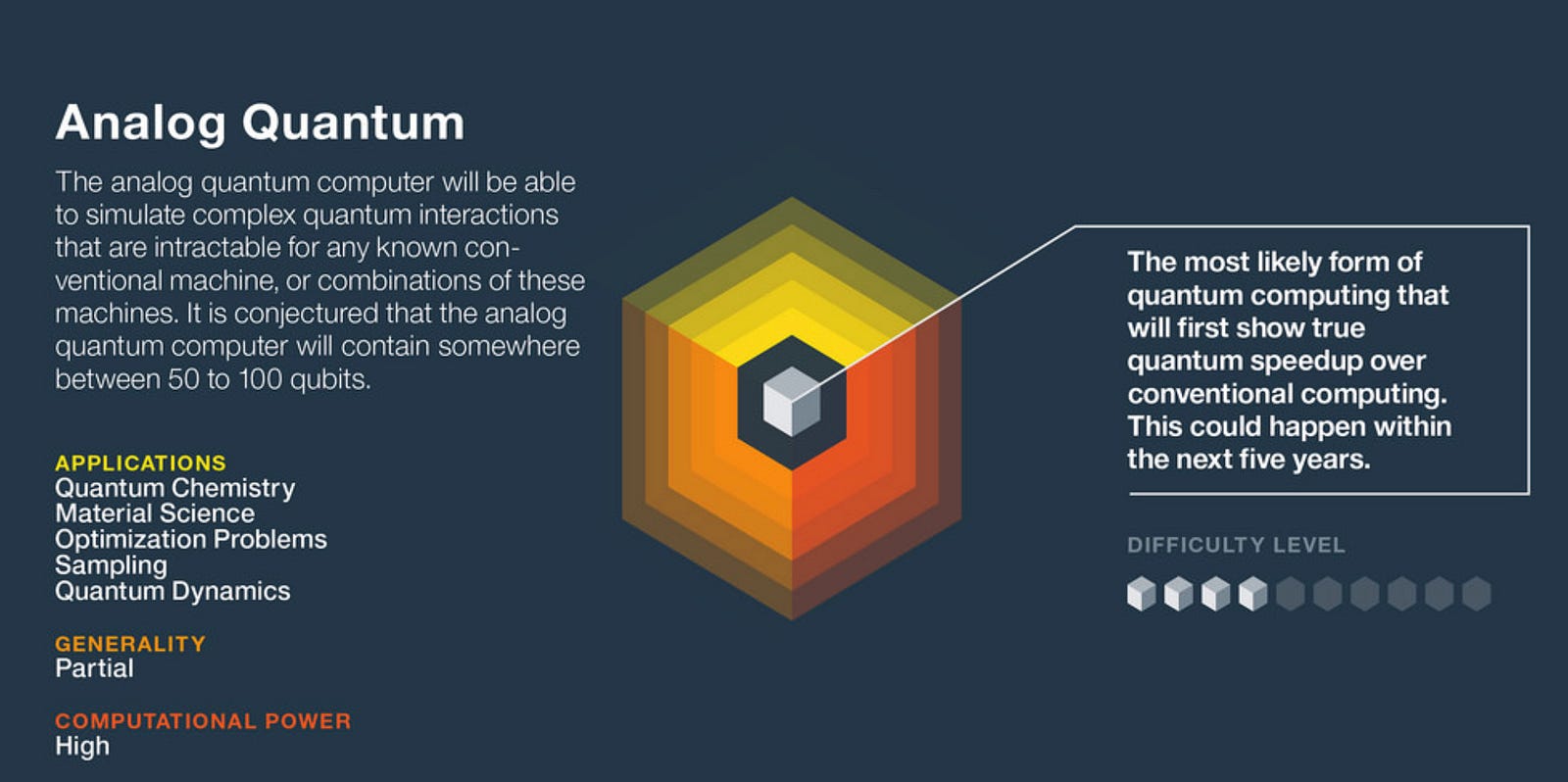
Analog Quantum
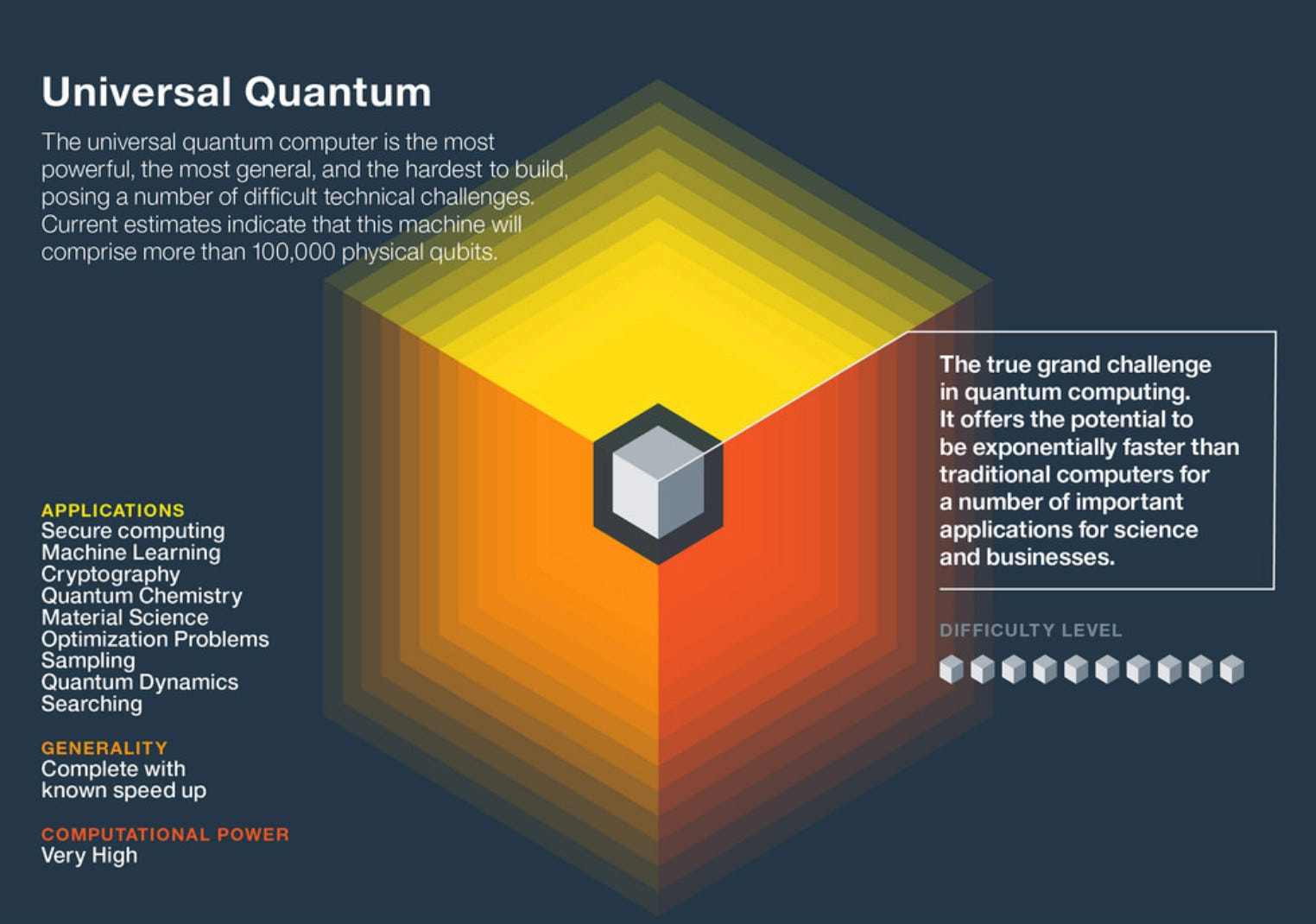
Universal Quantum
References
Wikipedia, IEEE, IBM Q, FutureLearn, Hackernoon, TED-Ed, TED Talks-> Quantum computing, Nutshell, Singularity Hub, Stack Exchange, Research Gate, Autodesk
 TECH GEEK